

Product
-
Weather station
-
Road Weather Station
-
Photovoltaic Inspection
-
Atmospheric monitoring
-
Operating condition monitoring
Recommended article
- photovoltaic testers 400V/20A Range Meets the On-Site Testing Needs of Photovoltaic Modules
- Application of Low-Power Meteorological observation equipment in Unattended Field Monitoring
- How Portable Solar Cell Testers Rapidly Perform PV String I-V Curve Testing
- The price of meteorological monitoring systems varies from 3,900 to 39,800 yuan depending on the number of monitored elements
- Power Quality Measurement Makes Power Grid Harmonic Detection and Data Logging More Efficient
- High-Precision Meteorological observation equipment Aids Field Environmental Monitoring
Contact us
Shandong Fengtu IOT Technology Co., Ltd
Sales Manager:Ms. Emily Wang
Cel,Whatsapp,Wechat:+86 15898932201
Email:info@fengtutec.com
Add:No. 155 Optoelectronic Industry Accelerator, Gaoxin District, Weifang, Shandong, China
Building a Meteorological Station: Steps and Considerations
Article source:Weather station time:2024-10-09 08:54:53 viewed:520times
I. Determine requirements and functions
Clearly define the meteorological parameters you hope the Meteorological station to measure, such as temperature, humidity, air pressure, wind speed, wind direction, rainfall, etc.
Determine the functions of the Meteorological station according to actual needs, such as data storage, wireless transmission, real-time display, etc.
II. Select sensors
Temperature sensor: You can choose a digital temperature sensor such as DS18B20, which has the characteristics of high precision, low cost, and ease of use.
Humidity sensor: Common ones are digital humidity sensors such as DHT11 and DHT22, which can accurately measure relative humidity.
Air pressure sensor: Such as BMP180, BMP280, etc., can measure atmospheric pressure.
Wind speed and direction sensor: You can choose a small three-cup anemometer and wind vane to measure wind speed and direction.
Rainfall sensor: There are tipping bucket rainfall sensors, radar rainfall sensors, etc., which can measure rainfall.
III. Hardware design
Microcontroller selection: You can choose open-source hardware platforms such as Arduino and Raspberry Pi as the control core of the Meteorological station. These platforms have rich resources and community support, making it convenient for development and debugging.
Circuit design: Design corresponding circuit connections according to the selected sensors and microcontrollers. Ensure stable and reliable communication between the sensor and the microcontroller.
Power supply: You can choose battery power or solar power. Determine the power supply scheme according to the actual situation. Ensure that the Meteorological station can work stably in an outdoor environment.
Shell design: Design a suitable shell to protect electronic components and sensors. You can use 3D printing or make your own shell to ensure that the shell has waterproof, dustproof, and anti-interference properties.
IV. Software programming
Select a programming language: Select an appropriate programming language according to the type of microcontroller. For example, Arduino uses C/C++, and Raspberry Pi can use Python, etc.
Sensor driver: Write programs to read and process sensor data. According to the sensor's communication protocol, use corresponding libraries or code to drive the sensor.
Data storage and transmission: If data needs to be stored, storage devices such as SD cards and EEPROM can be used. If wireless data transmission is required, wireless communication modules such as Bluetooth, Wi-Fi, or LoRa can be selected, and corresponding programs can be written to achieve data transmission.
Display and control: If real-time display of meteorological data is required, a display screen such as an OLED screen or LCD screen can be connected. Write programs to control the display screen to display meteorological parameters.
V. Test and debug
After completing the hardware and software design, conduct testing and debugging. First, check whether the circuit connection is correct and whether the sensor is working properly.
Conduct functional tests to verify whether the Meteorological station can accurately measure meteorological parameters and perform data storage and transmission.
Conduct outdoor tests on the Meteorological station and test its performance and stability under different environmental conditions. Adjust and optimize according to the test results.
VI. Improve and deploy
According to the test results, further improve and optimize the Meteorological station. For example, improve shell design, optimize power management, and improve data accuracy.
Determine the deployment location of the Meteorological station, choose a suitable outdoor environment, and ensure that the sensor can accurately measure meteorological parameters. Install the Meteorological station and perform fixation and protection.
Regularly maintain and calibrate the Meteorological station to ensure its long-term stable operation.
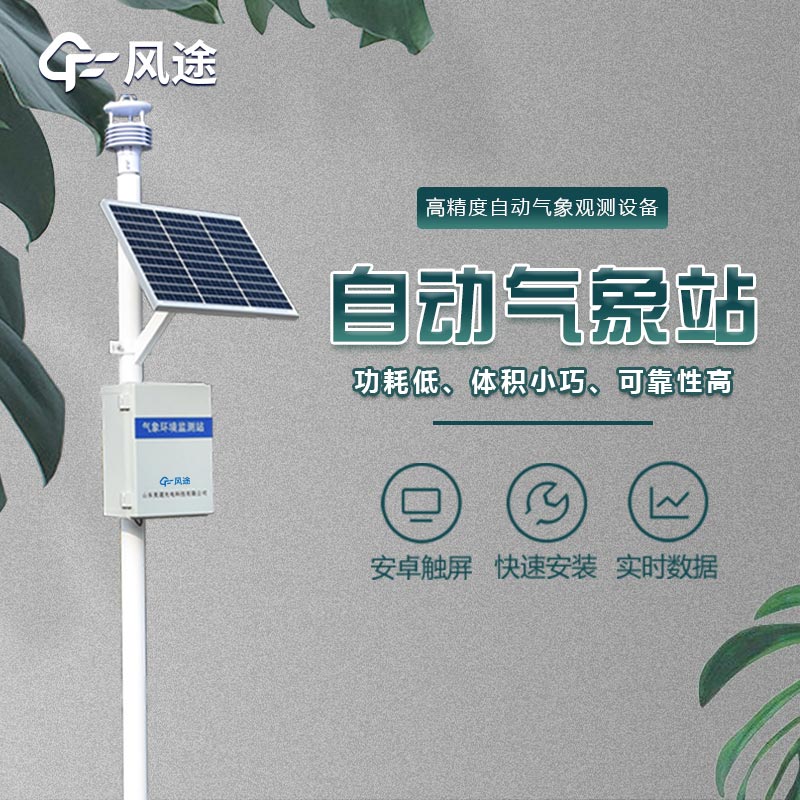
This paper addresses:https://fengtuweather.com/industry/525.html
Related products
Related article
-
How Much Does an Environmental Monitor Cost? — A Comprehensive Market Overview
2026-05-08 -
Vehicle-Mount Weather Stations: Mobile Solutions for Environmental Monitoring and Air Quality Analysis
2025-05-26 -
EL Test Power Supply is used for batch EL defect detection and production testing of photovoltaic modules
2025-12-24 -
Meteorological Observation Station: Unraveling the Mysteries of Weather
2024-09-20 -
Microclimate monitoring equipment for agriculture
2024-07-12 -
Six-Element Weather Station: Precise Monitoring of Basic Meteorological Elements, Adaptable to Multiple Industries
2026-03-03 -
Solar Powered Weather Station Enabling Unattended Field Monitoring via MPPT Technology
2026-04-17 -
Ground Penetrating Radar: A Reliable Solution for Detecting Abandoned Mines and Ensuring Engineering Safety
2025-07-23