

Product
-
Weather station
-
Road Weather Station
-
Photovoltaic Inspection
-
Atmospheric monitoring
-
Operating condition monitoring
Recommended article
- photovoltaic testers 400V/20A Range Meets the On-Site Testing Needs of Photovoltaic Modules
- Application of Low-Power Meteorological observation equipment in Unattended Field Monitoring
- How Portable Solar Cell Testers Rapidly Perform PV String I-V Curve Testing
- The price of meteorological monitoring systems varies from 3,900 to 39,800 yuan depending on the number of monitored elements
- Power Quality Measurement Makes Power Grid Harmonic Detection and Data Logging More Efficient
- High-Precision Meteorological observation equipment Aids Field Environmental Monitoring
Contact us
Shandong Fengtu IOT Technology Co., Ltd
Sales Manager:Ms. Emily Wang
Cel,Whatsapp,Wechat:+86 15898932201
Email:info@fengtutec.com
Add:No. 155 Optoelectronic Industry Accelerator, Gaoxin District, Weifang, Shandong, China
How Photovoltaic Solar Environmental Monitoring System Empowers Fishery-Photovoltaic Complementation
Article source:Weather station time:2024-12-16 09:42:31 viewed:500times
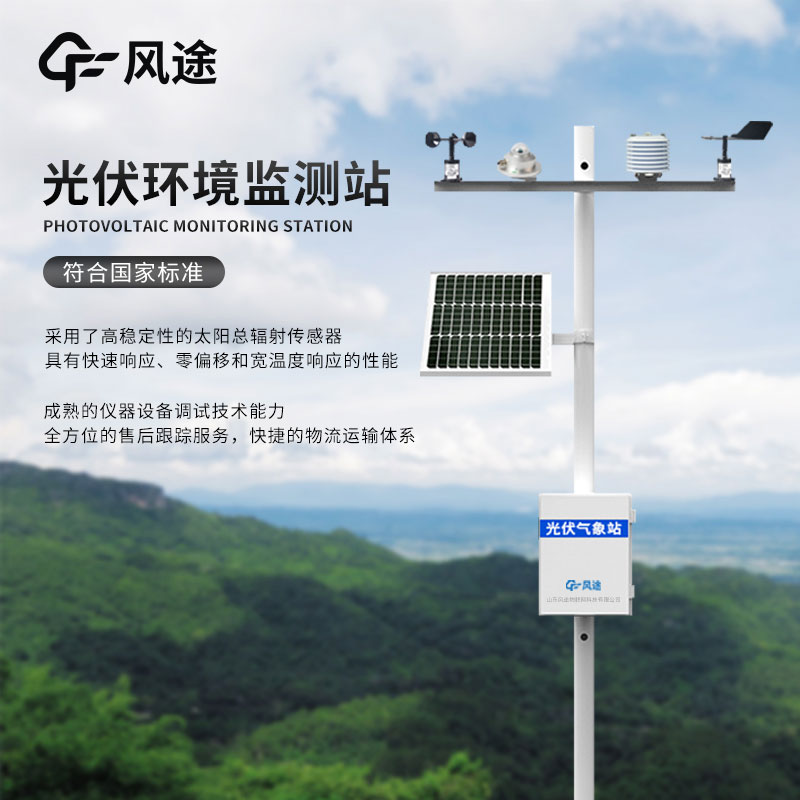
The Photovoltaic Solar Environmental Monitoring System consists of sensors, data loggers, communication modules, and a data processing platform. The sensors include those for temperature, light intensity, wind speed, wind direction, humidity, etc., which operate based on principles such as the thermoelectric effect, photoelectric conversion, ultrasonic time difference method, and capacitance change. The data logger collects and converts the sensor signals, and the communication module transmits the data to the processing platform for analysis, storage, and display. This system is of great significance to photovoltaic power stations. Temperature monitoring can prevent overheating of components, reducing efficiency or causing damage. Light intensity monitoring helps to assess the power generation potential and arrange maintenance. Wind speed and direction monitoring ensures the safety of the power station. Humidity monitoring can predict the condensation of components.
"Fishery-Photovoltaic Complementation" is a new model that combines photovoltaic power generation with aquaculture. Photovoltaic facilities are built on the water surface, and aquaculture is carried out underwater. The principle is that the photovoltaic modules reduce evaporation and water temperature by shading, creating a stable water temperature environment for aquaculture. The organic matter produced by aquaculture provides nutrients for plankton, forming a benign ecological cycle. This model has obvious advantages. It realizes the efficient utilization of land resources. For example, in coastal and lake areas, building power stations on the water surface does not occupy land resources. It brings double economic benefits. The photovoltaic power station generates profits, and properly planned aquaculture can also increase income. It is environmentally friendly. The shadow of the photovoltaic modules suppresses the outbreak of algae and improves water quality. The movement of fish increases oxygen, which is beneficial to the survival and reproduction of aquatic organisms.
In "Fishery-Photovoltaic Complementation", the water temperature sensor of the Photovoltaic Solar Environmental Monitoring System measures the water temperature in real time, helping farmers adjust strategies according to the water temperature requirements of the cultured species. The dissolved oxygen sensor monitors the dissolved oxygen content in the water. When the content is low, the aeration equipment is turned on in time. The pH sensor monitors the pH of the water body and maintains it within an appropriate range.
For the photovoltaic power station part, light intensity and temperature monitoring optimize the tilt angle and spacing of the components to improve power generation efficiency. Temperature monitoring ensures that the components do not overheat. Wind speed and wind direction monitoring provide data for the structural design and windproof of the power station, strengthening the supports or adjusting the component angles to reduce the risk of wind disasters.
In conclusion, the Photovoltaic Solar Environmental Monitoring System provides practical tools for the stable operation and development of the "Fishery-Photovoltaic Complementation" model.
This paper addresses:https://fengtuweather.com/industry/577.html
Related products
Related article
-
Weather Monitoring Equipment Low-Power Design and Advantages for Field Applications
2026-03-30 -
Online Dust Monitoring System: Intelligent Dust Suppression via Real-time PM Monitoring & Spraying Linkage
2025-06-24 -
Police radar gun Achieves Vehicle-Mounted Dynamic Speed Measurement and Data Management Based on the Doppler Effect
2026-06-24 -
Fengtu Vehicle-Mounted Weather Station Monitoring System: Empowering Mobile Meteorological Data Acquisition
2025-07-18 -
Ground Penetrating Radar: A Reliable Solution for Detecting Abandoned Mines and Ensuring Engineering Safety
2025-07-23 -
Grid-based environmental monitoring system, a refined environmental management model
2024-04-28 -
FT - FZ5 Negative Oxygen Ion Monitoring System: Your Reliable Air Guardian
2024-10-29 -
Explore Fengtu's Weather Instruments: From Automatic Stations to Handheld Meters
2025-02-06