

Product
-
Weather station
-
Road Weather Station
-
Photovoltaic Inspection
-
Atmospheric monitoring
-
Operating condition monitoring
Recommended article
- photovoltaic testers 400V/20A Range Meets the On-Site Testing Needs of Photovoltaic Modules
- Application of Low-Power Meteorological observation equipment in Unattended Field Monitoring
- How Portable Solar Cell Testers Rapidly Perform PV String I-V Curve Testing
- The price of meteorological monitoring systems varies from 3,900 to 39,800 yuan depending on the number of monitored elements
- Power Quality Measurement Makes Power Grid Harmonic Detection and Data Logging More Efficient
- High-Precision Meteorological observation equipment Aids Field Environmental Monitoring
Contact us
Shandong Fengtu IOT Technology Co., Ltd
Sales Manager:Ms. Emily Wang
Cel,Whatsapp,Wechat:+86 15898932201
Email:info@fengtutec.com
Add:No. 155 Optoelectronic Industry Accelerator, Gaoxin District, Weifang, Shandong, China
How Negative Ion Monitoring Enhances Air Quality and Boosts Tourism in Forest Areas
Article source:Weather station time:2024-12-31 09:54:09 viewed:515times
The monitoring of negative ions in forest atmosphere and tourist scenic areas is an important indicator for measuring air quality and health benefits. Negative ions, as naturally occurring negatively charged air particles, have a positive impact on human health. Scientific research shows that when the concentration of negative ions in the atmosphere reaches 4000 per cubic centimeter, it is beneficial to human health. Therefore, the concentration of negative oxygen ions in tourist scenic areas has become a key parameter for measuring the quality of its air.
The regulations for the content of negative oxygen ions in tourist scenic areas are as follows:
When the average concentration of negative oxygen ions is between 1000 and 1500 per cubic centimeter, the standard of fresh air is achieved;
When the average reaches 4000 per cubic centimeter, the standard of good air quality is achieved;
When the average is between 10000 and 15000 per cubic centimeter, the first-class standard of international tourist resorts is achieved.
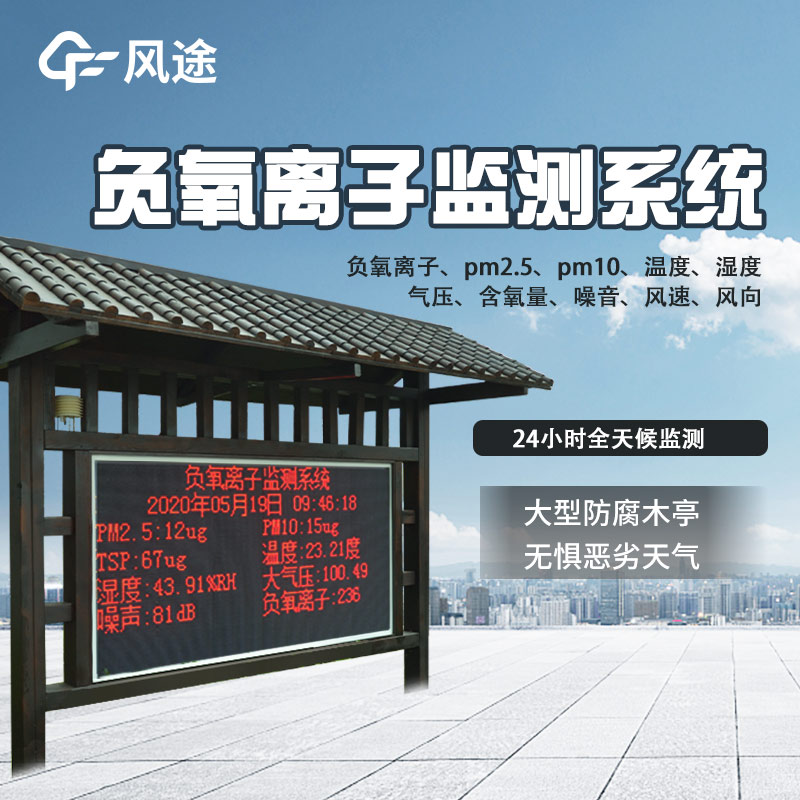
The negative oxygen ion monitoring system in tourist scenic areas has functions and characteristics such as real-time monitoring and display, data recording and analysis, alarm function, information display and guidance, data sharing and report generation.
Negative oxygen ion sensors are deployed within the tourist scenic area to monitor the concentration of negative oxygen ions in the air in real-time and display the data intuitively for management departments and tourists to view. The system records and saves historical monitoring data and conducts data analysis to evaluate the changing trend of the concentration of negative oxygen ions.
Set the threshold value of the negative oxygen ion concentration, and trigger an alarm when it exceeds the set value to remind the management department to take improvement measures. Display the monitoring data in a visual way, such as setting up an information display screen or providing a mobile application program. Share the monitoring data with the public or relevant institutions and generate reports to evaluate the negative oxygen ion environmental conditions in the scenic area.
In the standard DB11/T 477—2023, it is mentioned that the forest environmental indicators include negative oxygen ions, with the unit of per cubic centimeter (n/cm³), and the automatic monitoring frequency is to record once every 10 minutes.
The proposal of the Forest Air Ion Evaluation Index (FCI) provides a quantitative tool for the evaluation of forest air negative ions, where FCI = n⁻/1000 × p, with n⁻ being the negative ion concentration and p being the air negative ion coefficient.
The monitoring of negative ions in forest atmosphere and tourist scenic areas not only helps to evaluate and improve air quality but also provides health protection for tourists. By establishing and improving the Negative Oxygen Ion Monitoring System, we can better protect and utilize this precious natural resource and promote the sustainable development of the tourism industry.
This paper addresses:https://fengtuweather.com/industry/589.html
Related products
Related article
-
Vehicle-Mount Weather Station:Mobile Weather, Instant Response
2025-04-18 -
What is a facility agro-weather station?
2024-02-04 -
Photovoltaic module efficiency testing equipment Provides High-Voltage, High-Power Performance Testing Solutions
2026-01-04 -
Fengtu Technology: Dust Monitoring Equipment and Product Series
2025-10-21 -
GNSS Monitoring Stations: Ensuring Slope Stability and Enabling Early Landslide Warning
2025-11-12 -
Advantages of the box-type radar speedometer
2024-01-22 -
Mechanical weather station fills the "blind spots" in meteorological monitoring!
2024-09-23 -
Lightning Protection in Coal Mines and Lightning Warning System
2025-06-17