

Product
-
Weather station
-
Road Weather Station
-
Photovoltaic Inspection
-
Atmospheric monitoring
-
Operating condition monitoring
Recommended article
- photovoltaic testers 400V/20A Range Meets the On-Site Testing Needs of Photovoltaic Modules
- Application of Low-Power Meteorological observation equipment in Unattended Field Monitoring
- How Portable Solar Cell Testers Rapidly Perform PV String I-V Curve Testing
- The price of meteorological monitoring systems varies from 3,900 to 39,800 yuan depending on the number of monitored elements
- Power Quality Measurement Makes Power Grid Harmonic Detection and Data Logging More Efficient
- High-Precision Meteorological observation equipment Aids Field Environmental Monitoring
Contact us
Shandong Fengtu IOT Technology Co., Ltd
Sales Manager:Ms. Emily Wang
Cel,Whatsapp,Wechat:+86 15898932201
Email:info@fengtutec.com
Add:No. 155 Optoelectronic Industry Accelerator, Gaoxin District, Weifang, Shandong, China
Advantages of online noise detectors
Article source:Weather station time:2024-03-29 09:19:14 viewed:490times
Noise online detector is a real-time noise level monitoring equipment, which has the following advantages in controlling noise pollution:
Providing real-time data: the monitoring equipment can continuously record the noise level and provide accurate information for the formulation of prevention and control measures.
Automated monitoring: The equipment operates automatically without manual inspection and can detect noise exceeding the standard in time and upload data in real time.
Cost saving: Through continuous monitoring, the cost of labour and equipment purchase is reduced.
Early warning and emergency support: The equipment can quickly detect noise problems, issue early warnings, and help management respond in time to control noise pollution.
When selecting an environmental noise monitoring system, attention should be paid to key points such as brand reputation, equipment performance, applicability, price and after-sales service. Combining these factors to select the right system will ensure a highly effective and reliable environmental monitoring equipment.
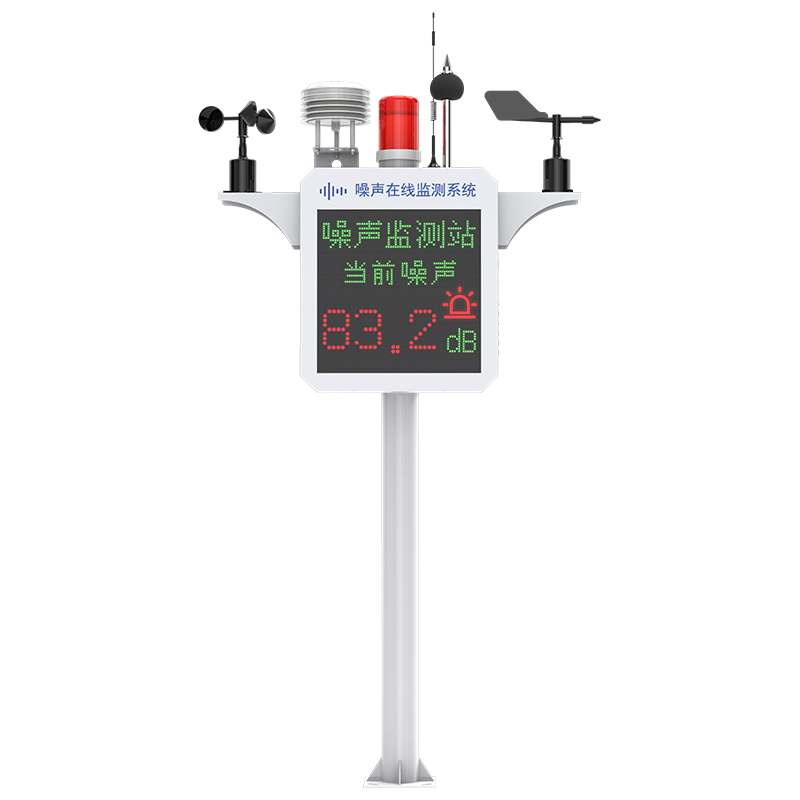
Noise detectors are mainly composed of the following parts:
Remote Telemetry Terminal: This is the core part of the device, which can set the time interval for data upload and supports various power supply methods, including dual power supply from solar and mains. It is installed inside the LED dual-colour display box and can communicate via 4G network.
LED Dual Colour Display: This is part of the user interface and the title of the display can be changed via the app and specific alert messages will be displayed in the event of communication anomalies. The display will show different coloured fonts depending on the noise level to visually reflect the current noise status.
Noise Sensor: This is the key component for detecting the noise level. It adopts a high sensitivity condenser microphone for sound intensity measurement with a wide measuring range and high accuracy.
Mounting Bracket: A fixed riser is provided to support and mount the entire noise detector.
Magnetic sound and light alarm: When the noise exceeds the set threshold, the alarm will emit sound and light alarm signals to remind the user to take appropriate measures. The alarm time period and threshold of the alarm can be set via Bluetooth APP.
This paper addresses:https://fengtuweather.com/industry/285.html
Related products
Related article
-
All-Weather Dust Monitoring Equipment: Functions, Advantages and Applications
2025-08-12 -
Road surface temperature monitoring station application range
2024-06-25 -
Intelligent Road Weather Information Systems for Traffic Safety
2025-10-28 -
The Role of Dust Detector in Construction Site Dust Monitoring and Early Pollution Control
2025-08-26 -
Recommended Manufacturers of Portable Weather Stations
2024-03-15 -
Functions of automatic meteorological monitoring station for field microclimate
2024-07-25 -
Multifunctional meteorological monitoring equipment for ten-element weather stations
2024-07-02 -
I-V Curve Tracer: Principles, Instrumentation and PV System Applications
2025-10-13