

Product
-
Weather station
-
Road Weather Station
-
Photovoltaic Inspection
-
Atmospheric monitoring
-
Operating condition monitoring
Recommended article
- photovoltaic testers 400V/20A Range Meets the On-Site Testing Needs of Photovoltaic Modules
- Application of Low-Power Meteorological observation equipment in Unattended Field Monitoring
- How Portable Solar Cell Testers Rapidly Perform PV String I-V Curve Testing
- The price of meteorological monitoring systems varies from 3,900 to 39,800 yuan depending on the number of monitored elements
- Power Quality Measurement Makes Power Grid Harmonic Detection and Data Logging More Efficient
- High-Precision Meteorological observation equipment Aids Field Environmental Monitoring
Contact us
Shandong Fengtu IOT Technology Co., Ltd
Sales Manager:Ms. Emily Wang
Cel,Whatsapp,Wechat:+86 15898932201
Email:info@fengtutec.com
Add:No. 155 Optoelectronic Industry Accelerator, Gaoxin District, Weifang, Shandong, China
Are field microclimate observatories useful?
Article source:Weather station time:2024-04-15 09:12:12 viewed:533times
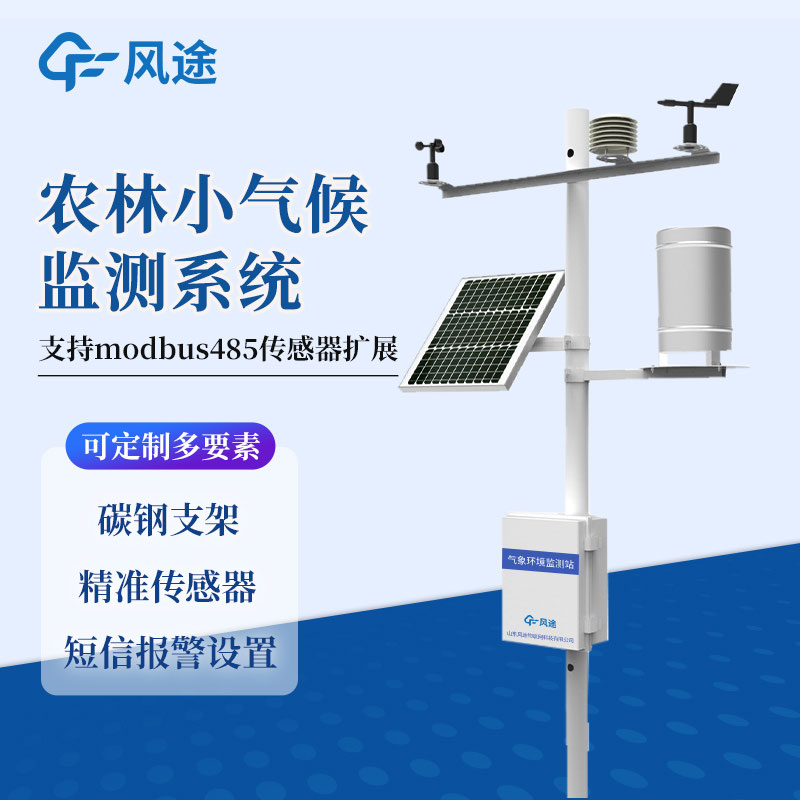
Meteorological stations play an important role in agricultural production by providing critical information needed for agricultural planning and crop planting arrangements. Crops depend on favourable climatic conditions, such as temperature, humidity, light and water. Through the continuous monitoring and data recording of these elements by agrometeorological stations, agricultural producers can better plan and adjust their production activities, thereby enhancing the efficiency and economic benefits of agricultural production. Data from weather stations help ensure that crops can thrive under optimal growing conditions, leading to abundant output and profitability.
In recent years, the use of field microclimate stations in field management has become more common as the agricultural farming industry continues to progress. The main function of these weather stations is to monitor various meteorological conditions on farmland in real time, including temperature, humidity, wind speed, wind direction, precipitation and light intensity. By collecting these key data, agro-weather stations help farmers understand more accurately the environmental conditions under which their crops grow, so that they can make more reasonable planting decisions, optimise the allocation of agricultural resources, and improve crop yields and quality. The application of such scientific and technological means is of great significance in enhancing the science and accuracy of agricultural production.
The field microclimate observatory collects meteorological information such as temperature and humidity in real time through the installed meteorological sensors. These data are collected by the collector and sent to the management platform through a wireless network. Users can access these data directly on their computers, facilitating real-time monitoring and analysing of farmland climate conditions.
In modern agriculture, weather stations are able to operate automatically under unattended conditions and adapt to a variety of terrains and environments, which significantly extends the coverage of weather monitoring and improves the accuracy and credibility of the data.
This paper addresses:https://fengtuweather.com/industry/335.html
Related products
Related article
-
Smart Tourism Anion Monitoring System
2024-08-26 -
This is a small weather station that works well ......
2024-02-29 -
Road Weather Station FT - GQX8: Empowering Traffic Decisions with Real - time Weather Data
2025-02-10 -
The Advantages of Modular Design in Mechanical Weather Stations
2025-04-03 -
Road Weather Station: Precision Monitoring, Intelligent Modeling, and Timely Warnings for Highway Safety
2025-02-26 -
Prairie Weather Stations Promote Data Sharing
2024-05-08 -
Vehicle-Mount Weather Stations: All-in-One Solutions for Dynamic Meteorological Data Capture
2025-05-12 -
Agricultural Monitoring System: Bridging Terminal Devices and Management Platform for Agriculture
2025-03-10