

Product
-
Weather station
-
Road Weather Station
-
Photovoltaic Inspection
-
Atmospheric monitoring
-
Operating condition monitoring
Recommended article
- photovoltaic testers 400V/20A Range Meets the On-Site Testing Needs of Photovoltaic Modules
- Application of Low-Power Meteorological observation equipment in Unattended Field Monitoring
- How Portable Solar Cell Testers Rapidly Perform PV String I-V Curve Testing
- The price of meteorological monitoring systems varies from 3,900 to 39,800 yuan depending on the number of monitored elements
- Power Quality Measurement Makes Power Grid Harmonic Detection and Data Logging More Efficient
- High-Precision Meteorological observation equipment Aids Field Environmental Monitoring
Contact us
Shandong Fengtu IOT Technology Co., Ltd
Sales Manager:Ms. Emily Wang
Cel,Whatsapp,Wechat:+86 15898932201
Email:info@fengtutec.com
Add:No. 155 Optoelectronic Industry Accelerator, Gaoxin District, Weifang, Shandong, China
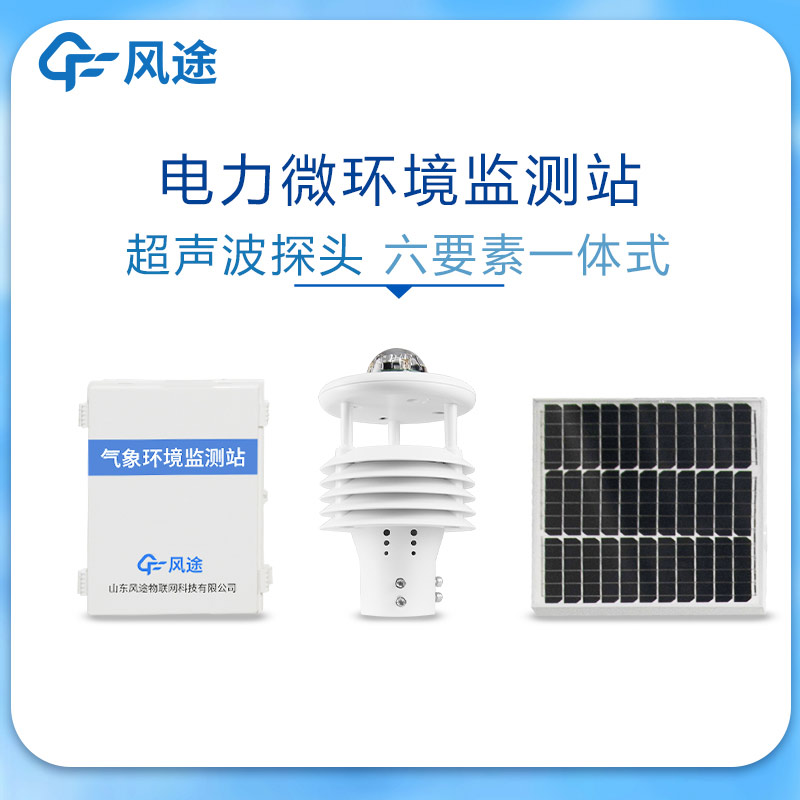
Substation micrometeorological environment monitoring
Article source:Weather station time:2024-06-18 08:42:27 viewed:486times
Micrometeorological zones are small areas with distinctive climatic characteristics due to unique geographical conditions. These areas may exhibit meteorological phenomena that are very different from those of their neighbours due to special topographic or aquatic environments, such as wind channels in canyons or around rivers and lakes. These areas are usually small and scattered.
Micro Weather Stations are a solution designed for monitoring micrometeorological environments, and typically these solar-powered devices are mounted on high voltage transmission towers. As high-voltage transmission lines cover a wide area and traverse a variety of terrains, including some areas with specific micrometeorological conditions, meteorological data for these areas are often difficult to obtain. In the absence of such critical data, power departments often have to rely on a wider range of general meteorological data when designing power grids, making it difficult to achieve accurate design for special areas.
It is equivalent to installing a self-sufficient miniature weather station on a transmission tower. It uses solar panels for energy supply and transmits key meteorological information such as humidity, temperature, wind direction, wind speed and precipitation in real time over a GPRS network. This data is critical for assessing the climatic conditions in a given micrometeorological zone, especially in the face of extreme weather events, and can help the power sector deploy more targeted patrols.
By collecting and analysing these micro-meteorological data, the power sector can more accurately guide the design and retrofitting of power grids in these particular areas, achieving a more refined and adaptable grid design.
This paper addresses:https://fengtuweather.com/industry/410.html
Related products
Related article
-
Introduction to the Integrated Forest Fire Risk Monitoring Station
2024-04-22 -
Handheld Laser Cloud Meter FT-YG2 Introduction
2024-05-07 -
Full Intelligent Control Soil and Water Conservation Digital High Precision Artificial Rainfall Simulation System
2024-04-17 -
Differences between grassland weather stations and other weather stations
2024-03-28 -
Ecological display, less scenic environment monitoring system
2024-05-24 -
Breaking Barriers: How Ultrasonic Smart Weather Station Simplifies Meteorological Observation
2025-01-03 -
Weather monitor Enables Low-Power, High-Precision Meteorological Monitoring in the Field
2026-05-21 -
Introduction to the Meteorological Department's Traffic Weather Visibility Monitoring Stations
2024-06-24