

Product
-
Weather station
-
Road Weather Station
-
Photovoltaic Inspection
-
Atmospheric monitoring
-
Operating condition monitoring
Recommended article
- photovoltaic testers 400V/20A Range Meets the On-Site Testing Needs of Photovoltaic Modules
- Application of Low-Power Meteorological observation equipment in Unattended Field Monitoring
- How Portable Solar Cell Testers Rapidly Perform PV String I-V Curve Testing
- The price of meteorological monitoring systems varies from 3,900 to 39,800 yuan depending on the number of monitored elements
- Power Quality Measurement Makes Power Grid Harmonic Detection and Data Logging More Efficient
- High-Precision Meteorological observation equipment Aids Field Environmental Monitoring
Contact us
Shandong Fengtu IOT Technology Co., Ltd
Sales Manager:Ms. Emily Wang
Cel,Whatsapp,Wechat:+86 15898932201
Email:info@fengtutec.com
Add:No. 155 Optoelectronic Industry Accelerator, Gaoxin District, Weifang, Shandong, China
What is an on-farm microclimate monitoring system?
Article source:Weather station time:2024-05-15 08:56:57 viewed:544times
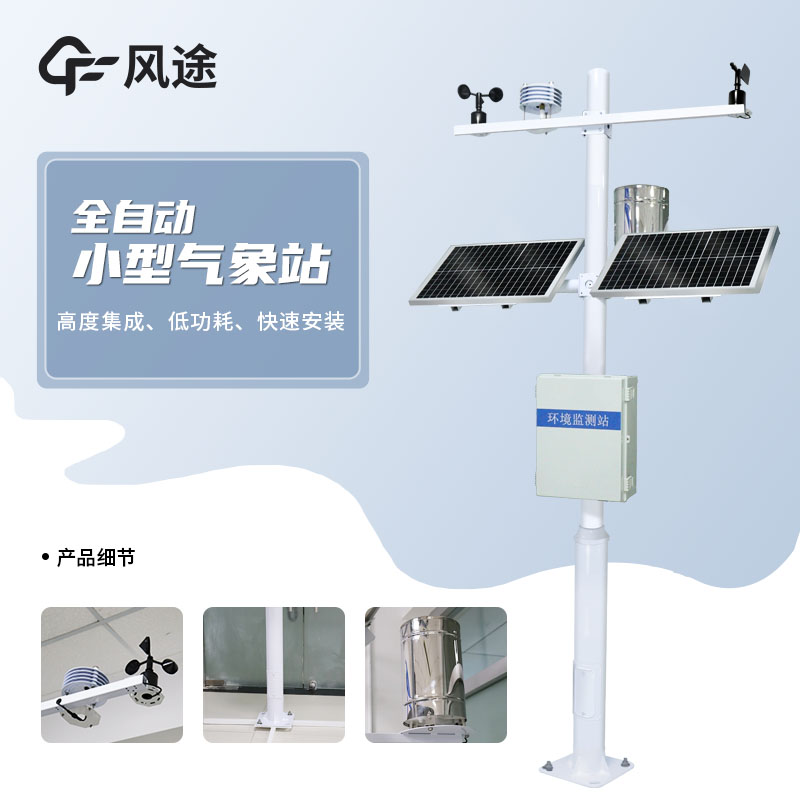
Agriculture is often affected by a variety of meteorological hazards, such as drought, floods, hail, frost and temperature extremes. Agrometeorological monitoring stations can monitor key meteorological indicators such as temperature, humidity, rainfall, wind speed and direction and solar radiation in real time, which are important guides for agricultural production. Installing these monitoring stations in key areas of agriculture helps to ensure safe crop production and promote the development of agriculture in the direction of higher quality and efficiency.
The farmland microclimate monitoring system is an intensive, energy-efficient, easy and rapidly deployable piece of modern agricultural technology equipment, which provides an important material basis for the transformation of agriculture into industrialisation. The system is able to monitor the climatic conditions and soil conditions of farmland in real time, helping to pinpoint the optimal timing and amount of water needed for irrigation. By taking into account the growth needs and ecological characteristics of crops, the technology helps to reduce unnecessary water wastage and realise water conservation in agriculture.
In order to mitigate losses caused by agricultural disasters, it is crucial to establish an agrometeorological disaster monitoring and early warning system. The system can monitor the farm environment in real time and provide timely warnings to farmers to help them take preventive measures. Through online monitoring of the agricultural production environment, combined with crop growth characteristics, the system is able to guide precise fertiliser application and irrigation, reduce resource wastage and improve agricultural production efficiency. The automation function of the farmland microclimate monitoring system makes irrigation and remote management more intelligent, while the system is simple to operate and easy for farmers to use. The system provides flexible data processing methods, making it easy for users to quickly access and analyse the information they need.
This paper addresses:https://fengtuweather.com/industry/375.html
Related products
Related article
-
Police radar gun Precise, Non-Contact Speed Measurement via Radio Waves
2026-03-27 -
Visibility Monitoring station in Modern Traffic Meteorological Systems: Functions, Data Transmission and Traffic Accident Reduction
2025-08-27 -
How Forest Weather Station Improves Forest Fire Risk Early Warning Capabilities Through Real-Time Data Acquisition
2026-07-20 -
The All - in - One Grassland Ecological Monitoring Station (FT - CQX9)
2025-01-23 -
Odor gas detector is used for precise odor monitoring in multiple scenarios
2026-03-04 -
Vehicle-Mount Weather Stations: All-in-One Solutions for Dynamic Meteorological Data Capture
2025-05-12 -
Ground Penetrating Radar: The Core Tool for Advanced Geological Prediction in Underground Engineering
2025-07-25 -
Series power supply Enabling Precise Detection of Internal Defects in PV Modules via Reverse-Bias Electroluminescence
2026-04-16