

Product
-
Weather station
-
Road Weather Station
-
Photovoltaic Inspection
-
Atmospheric monitoring
-
Operating condition monitoring
Recommended article
- photovoltaic testers 400V/20A Range Meets the On-Site Testing Needs of Photovoltaic Modules
- Application of Low-Power Meteorological observation equipment in Unattended Field Monitoring
- How Portable Solar Cell Testers Rapidly Perform PV String I-V Curve Testing
- The price of meteorological monitoring systems varies from 3,900 to 39,800 yuan depending on the number of monitored elements
- Power Quality Measurement Makes Power Grid Harmonic Detection and Data Logging More Efficient
- High-Precision Meteorological observation equipment Aids Field Environmental Monitoring
Contact us
Shandong Fengtu IOT Technology Co., Ltd
Sales Manager:Ms. Emily Wang
Cel,Whatsapp,Wechat:+86 15898932201
Email:info@fengtutec.com
Add:No. 155 Optoelectronic Industry Accelerator, Gaoxin District, Weifang, Shandong, China
How PV Weather Station Optimizes Photovoltaic Power Generation and Management
Article source:Weather station time:2024-11-28 09:45:03 viewed:478times
Photovoltaic systems rely highly on meteorological conditions. Solar radiation is the energy source, and the light intensity directly affects the power generation. The output power difference between sunny and cloudy days is significant. Temperature also cannot be overlooked. High temperature can cause the open-circuit voltage of photovoltaic cells to decrease and the photoelectric conversion efficiency to reduce. Appropriate wind speed can help with heat dissipation and improve efficiency, while excessive wind speed may damage the components.
Meteorological monitoring is of great significance for photovoltaic systems. In terms of power prediction, by monitoring and predicting meteorological elements such as solar radiation and temperature, the power generation can be estimated, helping the power grid to make reasonable scheduling. During system maintenance, warnings of severe weather can enable operation and maintenance personnel to take protective measures in advance. Long-term data combined with operation data can also optimize the maintenance plan. In the design stage, local meteorological data can determine parameters such as the installation location, angle, and spacing of the power station.
The development of the photovoltaic industry has also promoted the progress of meteorological monitoring technology. High-precision solar radiation sensors have been designed. The meteorological monitoring stations of photovoltaic power plants can not only serve themselves but also enrich meteorological observation data, making regional weather forecasts more accurate.
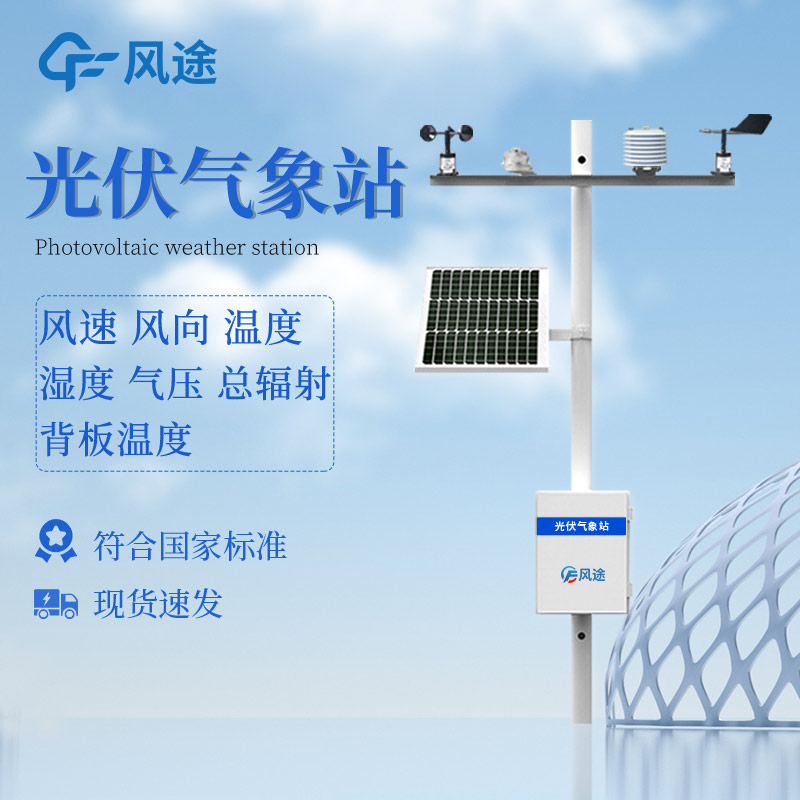
PV Weather Station, specifically designed for photovoltaic application scenarios, accurately monitors various meteorological elements such as solar radiation, temperature, humidity, wind speed, and wind direction, and transmits these data in real time to the control center of the photovoltaic system, thus safeguarding the efficient and stable operation of the photovoltaic power station and becoming an essential and important part of the photovoltaic industry.
This paper addresses:https://fengtuweather.com/industry/565.html
Related products
Related article
-
Road Weather Station: Monitoring for Safe Highways
2024-09-25 -
Dust Monitoring Equipment: Technology, Applications, and Contributions to Air Pollution Control
2025-10-29 -
Effective Measures for Construction Site Dust Control with Online dust Monitoring system
2024-12-02 -
The Mobile Edge in Meteorology: Vehicle - Mount Weather Stations
2025-04-07 -
Portable Weather Station "Highlights"
2024-01-31 -
How Negative Oxygen Ion Monitoring Station Reflects Park's Ecological Health
2025-03-03 -
Breaking Barriers: How Ultrasonic Smart Weather Station Simplifies Meteorological Observation
2025-01-03 -
Negative Oxygen Ion Monitoring System Builds Scenic Image
2024-04-16