

Product
-
Weather station
-
Road Weather Station
-
Photovoltaic Inspection
-
Atmospheric monitoring
-
Operating condition monitoring
Recommended article
- photovoltaic testers 400V/20A Range Meets the On-Site Testing Needs of Photovoltaic Modules
- Application of Low-Power Meteorological observation equipment in Unattended Field Monitoring
- How Portable Solar Cell Testers Rapidly Perform PV String I-V Curve Testing
- The price of meteorological monitoring systems varies from 3,900 to 39,800 yuan depending on the number of monitored elements
- Power Quality Measurement Makes Power Grid Harmonic Detection and Data Logging More Efficient
- High-Precision Meteorological observation equipment Aids Field Environmental Monitoring
Contact us
Shandong Fengtu IOT Technology Co., Ltd
Sales Manager:Ms. Emily Wang
Cel,Whatsapp,Wechat:+86 15898932201
Email:info@fengtutec.com
Add:No. 155 Optoelectronic Industry Accelerator, Gaoxin District, Weifang, Shandong, China
Dust Detector: Key to Monitoring and Mitigating TSP, PM2.5 and PM10 at Construction Sites
Article source:Weather station time:2025-05-09 09:21:59 viewed:541times
TSP (Total Suspended Particulates), PM2.5 and PM10 are important indicators for measuring air quality and pose a serious threat to the environment and human health. TSP refers to particulate matter with an aerodynamic equivalent diameter of less than 100 micrometers, which can suspend in the air for a long time, affect visibility and reduce air quality. PM10 is particulate matter with an aerodynamic equivalent diameter of less than or equal to 10 micrometers, which can enter the upper respiratory tract of the human body and trigger diseases such as coughing and asthma. PM2.5 has an aerodynamic equivalent diameter of less than or equal to 2.5 micrometers, which can penetrate deep into the human lungs and even enter the blood circulation system, increasing the risk of cardiopulmonary diseases and causing great harm to human health.
Construction sites are one of the main sources of TSP, PM2.5 and PM10. During the construction process, a large amount of dust is generated in links such as earthwork excavation, handling and stacking of building materials, and vehicle transportation. When earthwork is excavated, the soil is turned over, and fine particles disperse into the air. Building materials such as sand and cement are likely to generate dust due to factors such as wind and mechanical vibration during handling and stacking. When transport vehicles drive on the construction site, the wheels rolling on the ground will also raise dust.
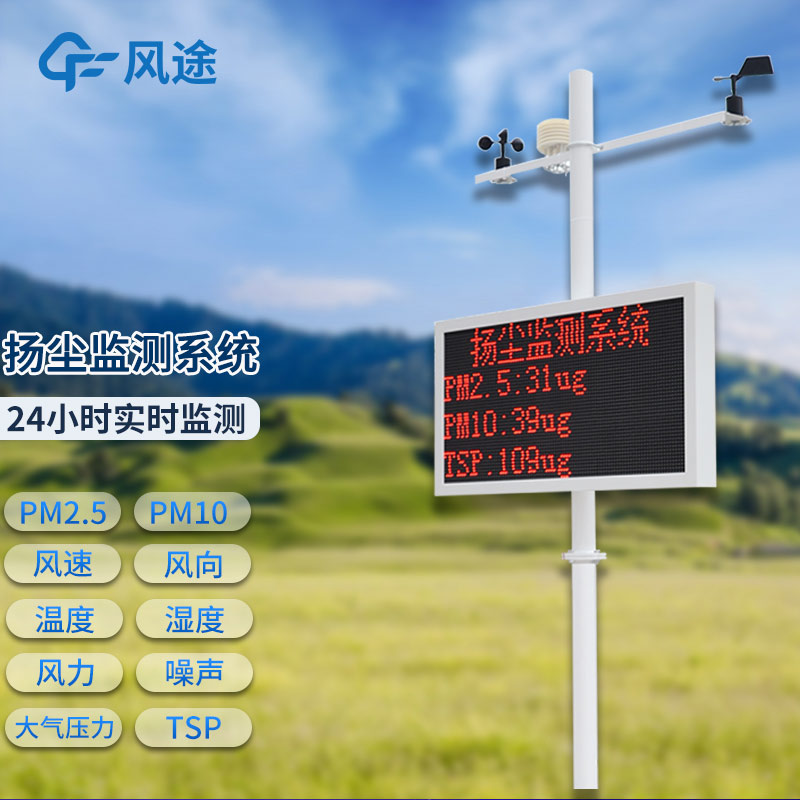
The Dust detector, based on Internet of Things and artificial intelligence technologies, can collect and transmit the environmental data of the construction site in real time, such as PM2.5, PM10, TSP, noise, wind speed, wind direction, etc. Its data can be displayed in real time on the on-site LED screen, the platform PC terminal and the mobile terminal, making it convenient for the regulatory authorities to remotely monitor and promptly detect the problem of excessive dust. When an alarm for excessive dust occurs, it can be linked with on-site fog cannons and other equipment to effectively control the pollution at the construction site, improve the efficiency of supervision and reduce dust pollution.
This paper addresses:https://fengtuweather.com/industry/697.html
Related products
Related article
-
Mobile Weather Stations: Versatile Tools for Meteorological Monitoring
2024-10-15 -
Natural Oxygen Bars in Scenic Spots: Negative Ion Monitoring for Healthy Tourism Development
2025-06-18 -
Portable 10-Parameter Monitoring: The FT-BQX10 Portable Weather Station for Emergency & Scientific Fieldwork
2025-11-11 -
Are field microclimate observatories useful?
2024-04-15 -
Weather monitor Enables Rapid Field Deployment Through High Integration and Low Power Consumption Design
2026-05-28 -
Functions, Advantages and Applications of Visibility Monitoring Station in Traffic Safety Guarantee
2025-08-21 -
Geological Disaster Monitoring Systems by Fengtu Technology
2025-09-08 -
Atmospheric Environment Monitoring System: The Key to Precise Pollution Control”
2024-10-11