

Product
-
Weather station
-
Road Weather Station
-
Photovoltaic Inspection
-
Atmospheric monitoring
-
Operating condition monitoring
Recommended article
- photovoltaic testers 400V/20A Range Meets the On-Site Testing Needs of Photovoltaic Modules
- Application of Low-Power Meteorological observation equipment in Unattended Field Monitoring
- How Portable Solar Cell Testers Rapidly Perform PV String I-V Curve Testing
- The price of meteorological monitoring systems varies from 3,900 to 39,800 yuan depending on the number of monitored elements
- Power Quality Measurement Makes Power Grid Harmonic Detection and Data Logging More Efficient
- High-Precision Meteorological observation equipment Aids Field Environmental Monitoring
Contact us
Shandong Fengtu IOT Technology Co., Ltd
Sales Manager:Ms. Emily Wang
Cel,Whatsapp,Wechat:+86 15898932201
Email:info@fengtutec.com
Add:No. 155 Optoelectronic Industry Accelerator, Gaoxin District, Weifang, Shandong, China
Dust monitoring and warning system function
Article source:Weather station time:2024-01-30 17:35:42 viewed:538times
With the rapid progress of urbanisation, environmental problems have become increasingly serious, and dust pollution has become a major challenge for urban environmental management. In order to effectively address this challenge, more and more cities are introducing dust monitoring and warning systems. The introduction of this system aims to monitor the concentration of dust in the air in real time, and once it exceeds the preset safety threshold, the system will automatically issue an alarm to remind the relevant personnel to take timely measures to effectively inhibit the spread of dust pollution, thereby improving urban air quality and creating a healthier and more livable living environment for residents.
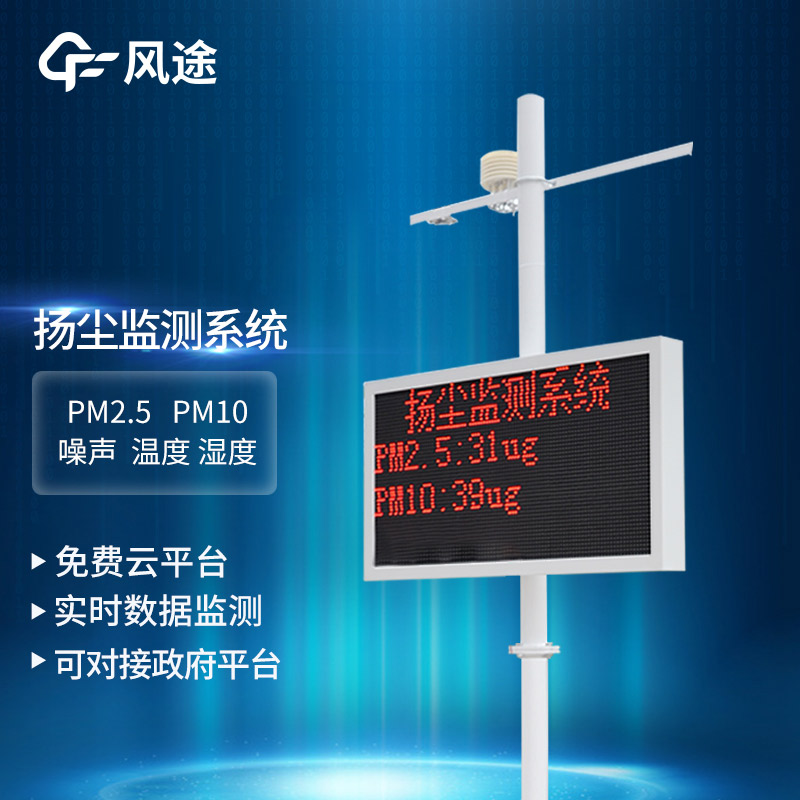
The dust monitoring and alarm system consists of three main parts: dust detector, dust cloud platform and 4G alarm. The system has powerful data collection and analysis capabilities, and is able to monitor meteorological data in real time and transmit these data to the dust cloud platform. Through the dust cloud platform, users can remotely view and analyse the data and remotely manage the equipment. This provides users with a large amount of accurate, detailed and effective data and a basis for judgement, which helps to better understand the situation of dust pollution and take appropriate measures.
When the monitoring data exceeds the preset safety threshold, the dust monitoring alarm system will immediately activate the linkage mechanism. By connecting the 4G voice alarms at different locations, the system reminds the staff to pay attention and take corresponding measures in a timely manner in the form of voice broadcasting, telephone shouting or SMS content broadcasting. This kind of reminder can ensure that the relevant personnel are informed of the situation in time and respond quickly, so as to effectively inhibit the spread of dust pollution and protect the urban environment.
The dust detector not only has the function of monitoring the concentration of airborne particles, such as PM2.5, PM10 and TSP, but also provides users with a wealth of meteorological elements options. According to the actual needs, users can easily add the monitoring of meteorological elements such as noise, temperature, humidity, wind speed, wind direction and atmospheric pressure. These diverse monitoring functions enable the dust detector to comprehensively and accurately reflect environmental conditions.
All monitored data, be it particulate concentration or meteorological elements, will be transmitted to the dust cloud platform via high-speed and stable 4G network or Ethernet. This design ensures real-time and reliable data, allowing users to access and understand the monitoring data at any time, no matter where they are. With the rapid advancement of urbanisation, environmental problems are becoming increasingly serious, and dust pollution has become a major challenge in urban environmental management. In order to effectively address this challenge, more and more cities are introducing dust monitoring and warning systems. The introduction of this system is aimed at monitoring the concentration of dust in the air in real time, and once it exceeds the preset safety threshold, the system will automatically issue an alarm to remind the relevant personnel to take timely measures to effectively inhibit the spread of dust pollution, thereby improving urban air quality and creating a healthier and more livable living environment for residents.
The dust monitoring and alarm system consists of three main parts: dust detector, dust cloud platform and 4G alarm. The system has powerful data collection and analysis capabilities, and is able to monitor meteorological data in real time and transmit these data to the dust cloud platform. Through the dust cloud platform, users can remotely view and analyse the data and remotely manage the equipment. This provides users with a large amount of accurate, detailed and effective data and a basis for judgement, which helps to better understand the situation of dust pollution and take appropriate measures.
When the monitoring data exceeds the preset safety threshold, the dust monitoring alarm system will immediately activate the linkage mechanism. By connecting the 4G voice alarms at different locations, the system reminds the staff to pay attention and take corresponding measures in a timely manner in the form of voice broadcasting, telephone shouting or SMS content broadcasting. This kind of reminder can ensure that the relevant personnel are informed of the situation in time and respond quickly, so as to effectively inhibit the spread of dust pollution and protect the urban environment.
The dust detector not only has the function of monitoring the concentration of airborne particles, such as PM2.5, PM10 and TSP, but also provides users with a wealth of meteorological elements options. According to the actual needs, users can easily add the monitoring of meteorological elements such as noise, temperature, humidity, wind speed, wind direction and atmospheric pressure. These diverse monitoring functions enable the dust detector to comprehensively and accurately reflect environmental conditions.
All monitored data, be it particulate concentration or meteorological elements, will be transmitted to the dust cloud platform via high-speed and stable 4G network or Ethernet. This design ensures real-time and reliable data, allowing users to access and understand the monitoring data at any time, no matter where they are.
This paper addresses:https://fengtuweather.com/industry/70.html
Related products
Related article
-
The price of fully automatic mini weather stations varies from 3900 to 9800 yuan depending on the number of monitored parameters
2026-05-15 -
Vehicle-Mount Weather Station in Action: Tackling Meteorological Disasters Head-On
2024-12-05 -
Why install a dust and noise monitoring system?
2024-05-29 -
Small Automatic Weather Stations: Enabling Precise Meteorological Monitoring Everywhere
2025-03-20 -
Tackling Power Quality Woes: The Function of Power Quality Analyzers
2025-03-21 -
Substation micrometeorological environment monitoring
2024-06-18 -
Dust Detector: A Smart Solution for Construction Site Dust Management
2025-04-23 -
Applications of Wind Speed Measuring Devices
2025-11-26