

Product
-
Weather station
-
Road Weather Station
-
Photovoltaic Inspection
-
Atmospheric monitoring
-
Operating condition monitoring
Recommended article
- photovoltaic testers 400V/20A Range Meets the On-Site Testing Needs of Photovoltaic Modules
- Application of Low-Power Meteorological observation equipment in Unattended Field Monitoring
- How Portable Solar Cell Testers Rapidly Perform PV String I-V Curve Testing
- The price of meteorological monitoring systems varies from 3,900 to 39,800 yuan depending on the number of monitored elements
- Power Quality Measurement Makes Power Grid Harmonic Detection and Data Logging More Efficient
- High-Precision Meteorological observation equipment Aids Field Environmental Monitoring
Contact us
Shandong Fengtu IOT Technology Co., Ltd
Sales Manager:Ms. Emily Wang
Cel,Whatsapp,Wechat:+86 15898932201
Email:info@fengtutec.com
Add:No. 155 Optoelectronic Industry Accelerator, Gaoxin District, Weifang, Shandong, China
Dust Monitoring Equipment in Waste Treatment Plants
Article source:Weather station time:2025-04-01 09:14:16 viewed:456times
Dust Monitoring Equipment in Waste Treatment Plants
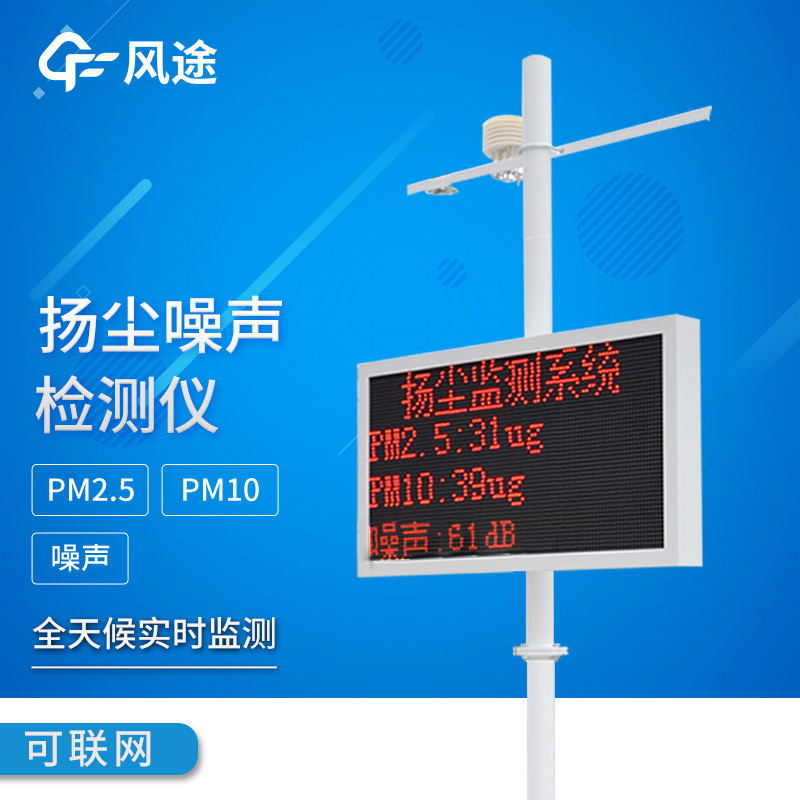
During the operations of waste transfer, landfill, incineration, etc. in waste treatment plants, dust pollution is highly likely to occur. These dust particles not only reduce the air quality and affect the physical health of the surrounding residents, but may also lead to the deterioration of the ecological environment such as the surrounding soil and water bodies. Therefore, installing a set of efficient and reliable Dust Monitoring Equipment is a crucial measure for waste treatment plants to achieve a win-win situation between clean production and environmental protection.
The Dust Monitoring Equipment in waste treatment plants generally consists of a sensing layer, a transmission layer, a data processing layer, and an application layer. The sensing layer is responsible for data collection and usually includes devices such as particulate matter sensors and meteorological sensors. The particulate matter sensors can accurately measure the concentrations of dust such as PM2.5, PM10, and TSP, while the meteorological sensors collect meteorological parameters such as wind speed, wind direction, temperature, and humidity. The transmission layer is responsible for transmitting the data collected by the sensing layer to the data processing layer through wired or wireless means. Common transmission methods include Ethernet, GPRS, 4G/5G, etc. The data processing layer cleans, stores, and analyzes the transmitted data, and the application layer presents the processed data to users in a visual form, making it convenient for the staff to grasp the dust situation in real time.
This system adopts the principle of light scattering. The dust particles in the air produce a light scattering effect under the irradiation of a high-energy laser beam, and the intensity of the scattered light is proportional to the concentration of the dust particles. A highly sensitive photodiode receives the scattered light, converts the optical signal into an electrical signal, which is amplified by an amplifier circuit, digitized by a single-chip microcomputer circuit, and then calculated according to a specific mathematical model to obtain the dust concentration data.
Core Functions:
I. Real-time Monitoring
The system can conduct 24-hour uninterrupted monitoring of multiple points in the waste treatment plant, achieving full-time control of dust pollution. The staff can view the real-time monitoring data anytime and anywhere through a computer or a mobile APP, and understand the dust dynamics in the plant at the first time.
II. Early Warning and Alarm
When the monitored data exceeds the preset threshold, the system will automatically issue an early warning signal and notify the relevant personnel in a timely manner through various means such as on-site audible and visual alarms, text messages on mobile phones, and platform push notifications. This enables the staff to quickly take dust suppression measures to prevent the further expansion of dust pollution.
III. Data Storage and Analysis
The system can store the monitored data for a long time, generate statistical reports and trend curves, providing data support for the management department to analyze the laws of dust pollution and evaluate the treatment effects. With the help of big data and artificial intelligence technologies, it can also predict the generation, diffusion, and settlement laws of dust, achieving accurate early warning and effective control.
IV. Linkage Control
The system can be linked with dust suppression equipment (such as fog cannons, sprinkler systems, etc.). When the dust concentration is monitored to exceed the standard, the dust suppression equipment will be automatically activated to reduce the dust content in the air and suppress dust pollution in a timely manner.
Case:
The Dust Monitoring Equipment launched by Fengtu Technology has been applied in monitoring scenarios of dust pollution sources such as a waste treatment station in a certain area. This system can not only collect and analyze data of various environmental elements and upload them to the dust cloud platform in real time, making it convenient for users to manage remotely, but also automatically turn on the audible and visual alarms and activate the on-site dust suppression devices when the monitored elements exceed the standard. The Dust Monitoring Equipment of the intelligent monitoring platform, through information-based management and Internet of Things intelligent technologies, has constructed multiple functional modules, achieving the interconnection of project and platform dust data, and greatly improving the industry supervision efficiency and enterprise management level.
This paper addresses:https://fengtuweather.com/industry/659.html
Related products
Related article
-
Power Quality Measurement For Rapid On-Site Troubleshooting of Electrical Circuits
2026-04-20 -
How Portable Solar Cell Testers Rapidly Perform PV String I-V Curve Testing
2026-07-27 -
Agricultural Weather Stations, making farming more modern and smarter
2024-08-16 -
Advantages of Small automatic weather station
2024-09-03 -
Breaking Through the ‘Last Meter’ with Online Dust Monitoring System
2025-01-10 -
Ultrasonic Snow Depth Detector Overcoming Snow Surface Detection Challenges Using Ultrasonic Measurement Principles
2026-04-27 -
Portable & Efficient: Road Weather Information System for Traffic Sectors
2025-09-18 -
Small meteorological monitoring stations for agriculture
2024-07-09