

Product
-
Weather station
-
Road Weather Station
-
Photovoltaic Inspection
-
Atmospheric monitoring
-
Operating condition monitoring
Recommended article
- photovoltaic testers 400V/20A Range Meets the On-Site Testing Needs of Photovoltaic Modules
- Application of Low-Power Meteorological observation equipment in Unattended Field Monitoring
- How Portable Solar Cell Testers Rapidly Perform PV String I-V Curve Testing
- The price of meteorological monitoring systems varies from 3,900 to 39,800 yuan depending on the number of monitored elements
- Power Quality Measurement Makes Power Grid Harmonic Detection and Data Logging More Efficient
- High-Precision Meteorological observation equipment Aids Field Environmental Monitoring
Contact us
Shandong Fengtu IOT Technology Co., Ltd
Sales Manager:Ms. Emily Wang
Cel,Whatsapp,Wechat:+86 15898932201
Email:info@fengtutec.com
Add:No. 155 Optoelectronic Industry Accelerator, Gaoxin District, Weifang, Shandong, China
Smart Construction Sites: The Role of Dust Monitoring Equipment in Sustainable Urban Development
Article source:Weather station time:2025-09-23 09:54:36 viewed:532times
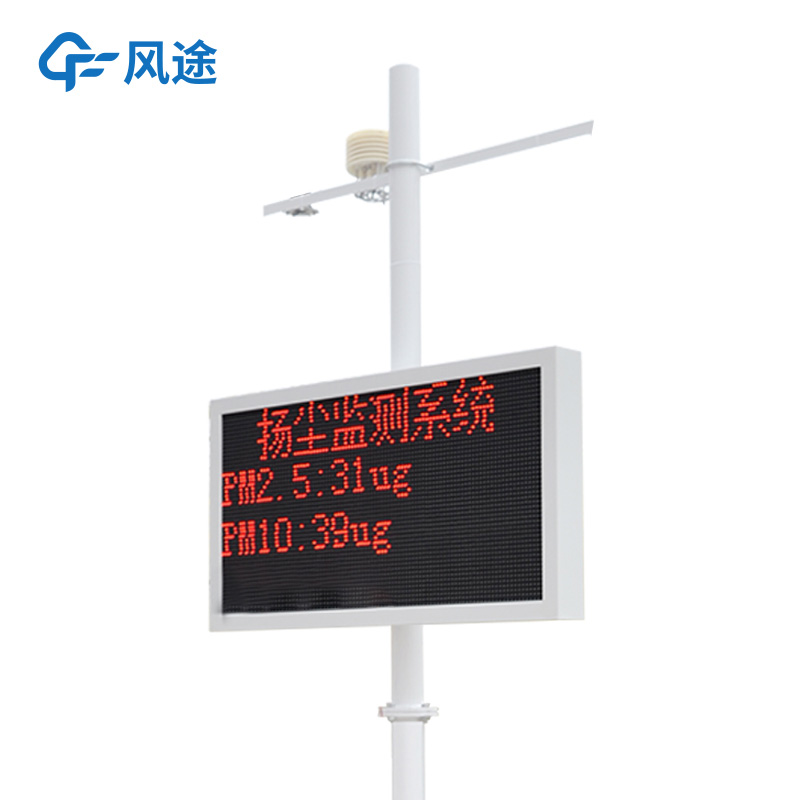
Dust pollution is a prominent environmental issue in the urbanization process. To prevent and control dust pollution, many construction sites have installed Dust Monitoring Equipment. This is an automated system integrating sensor technology, data acquisition, and wireless communication technology, used for real-time, continuous, and remote monitoring of particulate matter concentrations in the environment. It is an important component of smart environmental protection and digital construction sites.
Its value lies in transforming the traditional, passive manual inspection mode into an efficient, proactive intelligent supervision mode. Because it can continuously measure and record pollution indicators such as PM2.5, PM10, and TSP (Total Suspended Particulates) at monitoring points 24 hours a day. Once the monitoring data exceeds the preset environmental protection threshold, the system will immediately send automatic alarm information to supervisors via SMS, APP, platform, etc., realizing the transformation from "human prevention" to "technical prevention". It can also be linked with on-site fog cannons, spray devices, and enclosure spray systems, automatically activating dust suppression equipment when exceeding standards is detected, forming an intelligent closed-loop control of "monitoring-governance". Combined with video surveillance and meteorological parameters (wind speed, wind direction), it can help law enforcement personnel quickly trace pollution sources and provide irrefutable data and video evidence for environmental law enforcement.
Typically, a complete set of Dust Monitoring Equipment consists of the following "hardware" and "software" components:
The particulate matter monitor is the core component, adopting the light scattering method principle, capable of measuring real-time concentration values of PM2.5 and PM10 with high precision and high frequency (unit: μg/m³). Meteorological parameter sensors integrate monitoring of wind speed, wind direction, air temperature, humidity, etc. Because strong winds and dry weather can easily cause dust, measuring wind speed and direction helps trace pollution sources. Many devices also integrate noise sensors to simultaneously monitor construction noise pollution, meeting comprehensive environmental supervision needs.
All data is ultimately integrated into the cloud platform monitoring center, visually displaying concentration data, rankings, map locations and other information of each monitoring point. Historical data for any time period can be queried, and daily reports, monthly reports, trend curves, etc., are automatically generated to facilitate statistical analysis.
Dust Monitoring Equipment is mainly installed at air quality monitoring points around schools, hospitals, and residential areas, or along linear engineering such as municipal engineering road construction, pipeline laying, and bridge construction, concrete mixing plants, asphalt mixing plants, sand yards, coal yards, ports and terminals, etc., as well as key locations such as construction/demolition site entrances, foundation pit surroundings, and main operation areas.
This paper addresses:https://fengtuweather.com/industry/799.html
Related products
Related article
-
Portable Weather Station: Your Pocket-Sized Environmental Companion
2024-11-07 -
Solar-Powered IoT Monitoring: The FengTu FT-QC12 Automatic Weather Station
2025-11-05 -
The Hazards of Airborne Particulate Matter (PM) and the Role of PM2.5 Air Quality Monitor
2024-11-14 -
Energy-Efficient Small Automatic Weather Station: Wireless Data Transmission for Smart Monitoring
2025-06-11 -
What is a speeding photo solar display?
2024-04-19 -
Agrometeorological Station, Intelligent Platform Integrating Internet of Things (IoT) Technology
2024-02-02 -
Introduction to forest security monitoring systems
2024-04-12 -
Enhanced Mobility and Safety: The Role of Vehicle-Mount Weather Station
2024-12-25