

Product
-
Weather station
-
Road Weather Station
-
Photovoltaic Inspection
-
Atmospheric monitoring
-
Operating condition monitoring
Recommended article
- photovoltaic testers 400V/20A Range Meets the On-Site Testing Needs of Photovoltaic Modules
- Application of Low-Power Meteorological observation equipment in Unattended Field Monitoring
- How Portable Solar Cell Testers Rapidly Perform PV String I-V Curve Testing
- The price of meteorological monitoring systems varies from 3,900 to 39,800 yuan depending on the number of monitored elements
- Power Quality Measurement Makes Power Grid Harmonic Detection and Data Logging More Efficient
- High-Precision Meteorological observation equipment Aids Field Environmental Monitoring
Contact us
Shandong Fengtu IOT Technology Co., Ltd
Sales Manager:Ms. Emily Wang
Cel,Whatsapp,Wechat:+86 15898932201
Email:info@fengtutec.com
Add:No. 155 Optoelectronic Industry Accelerator, Gaoxin District, Weifang, Shandong, China
Integrated meteorological monitoring station High-Efficiency Monitoring for Multi-Domain Applications
Article source:Weather station time:2026-01-28 09:44:32 viewed:521times
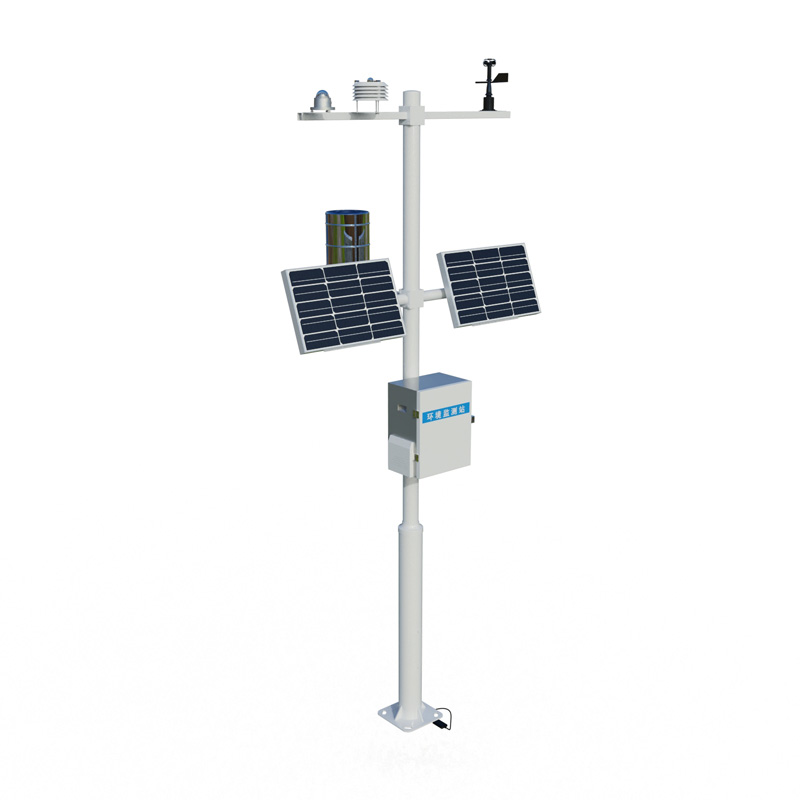
Integrated meteorological monitoring station is an intelligent device capable of continuously and automatically monitoring various meteorological, hydrological, and soil parameters. It integrates various meteorological sensors, data collectors, a solar power system, a mounting pole, and a cloud platform. Featuring easy installation and rapid deployment, it provides real-time, high-quality comprehensive monitoring data and is widely used in meteorology, agriculture, forestry, environmental protection, marine science, airports, ports, scientific research, and campus education.
Integrated meteorological monitoring station is a crucial component of modern environmental monitoring networks. The core design concept of this device is integrated comprehensive measurement, enabling the simultaneous collection of atmospheric temperature, humidity, wind speed, wind direction, precipitation, solar radiation, and atmospheric pressure. It can also integrate hydrological and soil moisture sensors to meet the needs of comprehensive environmental condition monitoring. Its deployment and operation are highly automated; users can quickly complete site setup and put the system into operation without complex debugging, greatly improving the efficiency of monitoring network construction.
A standard Integrated meteorological monitoring station consists of five main components working together. Meteorological sensors are responsible for sensing various environmental variables and are the basis of data acquisition. The data collector acts as the control center, processing sensor signals and performing initial data integration and storage. The solar power system, coupled with batteries, ensures continuous and stable energy supply, guaranteeing long-term operation in unattended outdoor environments. The mounting pole provides a stable installation platform for all equipment, adapting to various terrain conditions. The cloud platform is the final destination of the data; it receives remotely transmitted data from the collector, providing real-time display, historical data retrieval, statistical analysis, and early warning functions, enabling cloud-based management and in-depth application of monitoring data.
The significant advantages of this device lie in its high degree of integration and reliability. It integrates sensing technology, Internet of Things communication technology, and new energy power supply technology, enabling stable real-time monitoring and remote data transmission. The continuous, high-quality data series it provides is an important foundation for accurate weather forecasting, precision agriculture management, environmental assessment, ensuring the operational safety of ports and airports, promoting scientific research projects, and conducting science education. In smart agriculture, it guides irrigation and fertilization; in forestry, it assists in forest fire risk level forecasting; in environmental protection, it monitors regional air quality; and in scientific research and education, it provides firsthand observational data and teaching examples. In summary, Integrated meteorological monitoring station, with its comprehensive, automated, and easily deployable features, has become a key infrastructure supporting refined management and scientific decision-making across multiple industries. By providing real-time and reliable environmental data, it effectively serves numerous sectors of the national economy, reflecting the trend of modern monitoring technology towards intelligence, networking, and integration.
This paper addresses:https://fengtuweather.com/technical/871.html
Related products
Related article
-
The price of small integrated meteorological instruments ranges from 3900 to 39800 yuan
2026-06-15 -
How to choose a dust and noise monitor?
2024-07-16 -
How Landslide Monitoring Systems Work to Mitigate Geological Hazards
2024-12-04 -
Odor Monitoring System Employs Multi-Sensor Array Technology to Simulate Manual Olfactory Assessment
2026-07-13 -
Inhalable Dust Continuous Tester: A Portable Solution for Dust Concentration Monitoring
2025-01-08 -
Dust Detector: A Smart Solution for Construction Site Dust Management
2025-04-23 -
Price Variations in Six-Element Weather Stations: Driven by Sensor Principles and Configuration Requirements
2026-05-09 -
Forest Weather Monitoring System to protect against hill fires
2024-04-29