

Product
-
Weather station
-
Road Weather Station
-
Photovoltaic Inspection
-
Atmospheric monitoring
-
Operating condition monitoring
Recommended article
- photovoltaic testers 400V/20A Range Meets the On-Site Testing Needs of Photovoltaic Modules
- Application of Low-Power Meteorological observation equipment in Unattended Field Monitoring
- How Portable Solar Cell Testers Rapidly Perform PV String I-V Curve Testing
- The price of meteorological monitoring systems varies from 3,900 to 39,800 yuan depending on the number of monitored elements
- Power Quality Measurement Makes Power Grid Harmonic Detection and Data Logging More Efficient
- High-Precision Meteorological observation equipment Aids Field Environmental Monitoring
Contact us
Shandong Fengtu IOT Technology Co., Ltd
Sales Manager:Ms. Emily Wang
Cel,Whatsapp,Wechat:+86 15898932201
Email:info@fengtutec.com
Add:No. 155 Optoelectronic Industry Accelerator, Gaoxin District, Weifang, Shandong, China
IV Curve Testers: Measuring the Current-Voltage Characteristics of PV Modules
Article source:Weather station time:2026-05-07 09:55:07 viewed:248times
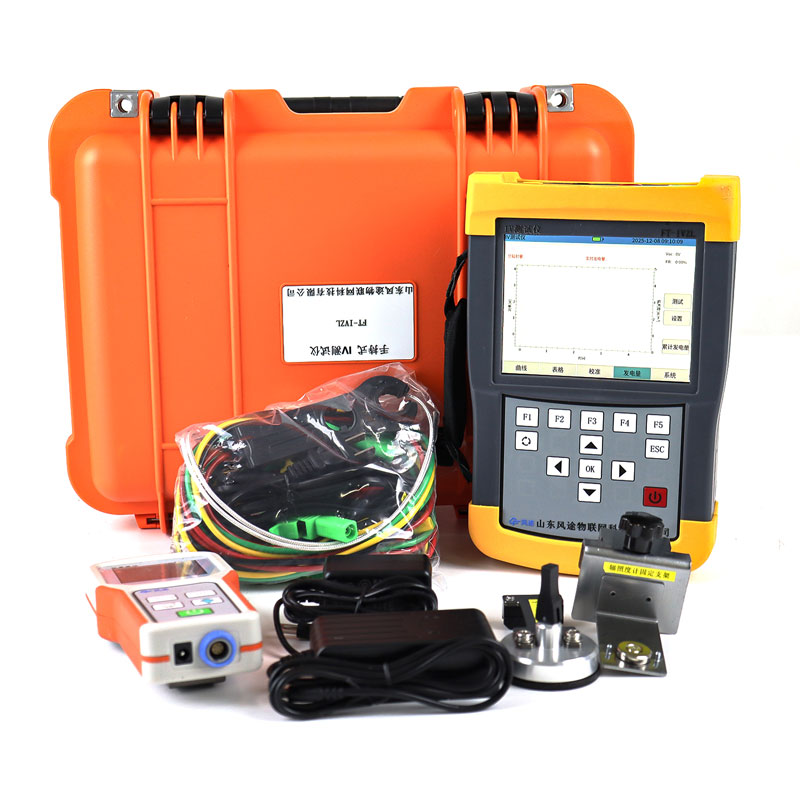
IV curve testers acquire current-voltage (IV) characteristic curves by varying the electrical load applied to a solar panel. Capable of measuring voltages up to 400V and currents up to 20A, these instruments can perform comprehensive assessments on PV modules with power ratings of up to 1000W. The device simultaneously monitors the panel's temperature and solar irradiance levels, outputting key parameters such as open-circuit voltage, short-circuit current, and maximum power.
The IV curve tester is a specialized analytical instrument designed specifically for measuring the current-voltage characteristics of photovoltaic (PV) modules; it plays a fundamental role in quality inspection and operations & maintenance (O&M) activities within the PV industry. The instrument primarily functions by varying the electrical load applied to a solar panel to generate a complete IV characteristic curve. Depending on the specific circuit design, the tester may employ a dynamic capacitor charging method: a capacitor is connected as a variable load to the output terminals of the PV array, allowing for the continuous sampling of voltage and current data during the charging process. Alternatively, the device may utilize a built-in electronic load module, which employs an adjustable voltage source to sequentially vary the operating voltage of the solar cell while recording the corresponding changes in current. Both methods ultimately enable the plotting of a complete IV curve, thereby facilitating an assessment of the PV module's performance status.
In terms of technical specifications, the tester features a voltage measurement range extending up to 400V and a current measurement capability of up to 20A, enabling it to perform comprehensive performance evaluations on PV modules with power ratings of up to 1000W. Key measurable parameters include open-circuit voltage (Voc), short-circuit current (Isc), maximum power (Pmax), the voltage and current at the maximum power point (Vmpp and Impp), and the fill factor (FF). Specifically, the open-circuit voltage represents the output voltage of the PV module under no-load conditions, while the short-circuit current represents the output current when the module is in a short-circuit state; the maximum power point corresponds to the module's peak output operating condition. The fill factor serves as a metric for the "squareness" of the IV curve; it is calculated by dividing the maximum power by the product of the open-circuit voltage and the short-circuit current. A higher fill factor value indicates superior output quality for the PV module.
The IV curve tester also incorporates an integrated environmental monitoring module, featuring capabilities for detecting both the solar panel's temperature and solar irradiance levels. A temperature sensor is affixed to the backsheet surface of the PV module to capture its operating temperature in real-time, while an irradiance sensor measures the ambient light intensity. These two sets of environmental data are critical for the standardized correction and normalization of the test results. Based on standard test condition parameters (irradiance of 1000 W/m² and cell temperature of 25°C), the instrument automatically converts field measurement data into equivalent values under standard conditions, thereby ensuring the comparability of test results obtained at different times and locations.
In practical applications within PV power plants, the I-V curve tracer enables the rapid diagnosis of common issues affecting PV modules. By analyzing changes in the shape of the I-V curve, O&M personnel can identify anomalies such as power degradation, shading, micro-cracks, hot spots, bypass diode failures, or aging connection wiring. By comparing the actual measured curves against the manufacturer's rated specifications, users can accurately assess the module's current performance level and detect potential latent faults. This device is easy to operate and highly portable, making it suitable for a wide range of scenarios—including PV power plant commissioning, routine O&M inspections, quality control testing, and scientific research experiments—and provides reliable technical support for the efficient operation of PV systems.
This paper addresses:https://fengtuweather.com/industry/935.html
Related products
Related article
-
Dust Monitoring Equipment: Bridging Data and Environmental Management Decisions
2024-12-12 -
Why install a dust and noise monitoring system?
2024-05-29 -
Forestry Weather Station: Your All-in-One Fire Risk Sentinel in the Woods
2024-12-09 -
Negative Oxygen Ion Monitoring Station: An Automated Solution for 24/7 Air Cleanliness Monitoring in Scenic Areas
2025-09-01 -
How do you measure negative oxygen ion concentration? Real-time this portable instrument
2024-04-07 -
photovoltaic testers is a portable photovoltaic module testing device
2025-12-01 -
Vehicle - Mount Weather Stations: Applications and Advantages
2024-11-11 -
Road Weather Station: Paving the Way for Intelligent Traffic Management
2024-11-29