

Product
-
Weather station
-
Road Weather Station
-
Photovoltaic Inspection
-
Atmospheric monitoring
-
Operating condition monitoring
Recommended article
- The price of meteorological monitoring systems varies from 3,900 to 39,800 yuan depending on the number of monitored elements
- Power Quality Measurement Makes Power Grid Harmonic Detection and Data Logging More Efficient
- High-Precision Meteorological observation equipment Aids Field Environmental Monitoring
- How Forest Weather Station Improves Forest Fire Risk Early Warning Capabilities Through Real-Time Data Acquisition
- The Electrical Power Analyzer's four-channel synchronous measurement capability enhances the efficiency of photovoltaic grid-connected testing
- How Ultrasonic Snow Depth Monitoring Stations Achieve Accurate Snow Depth Measurement
Contact us
Shandong Fengtu IOT Technology Co., Ltd
Sales Manager:Ms. Emily Wang
Cel,Whatsapp,Wechat:+86 15898932201
Email:info@fengtutec.com
Add:No. 155 Optoelectronic Industry Accelerator, Gaoxin District, Weifang, Shandong, China
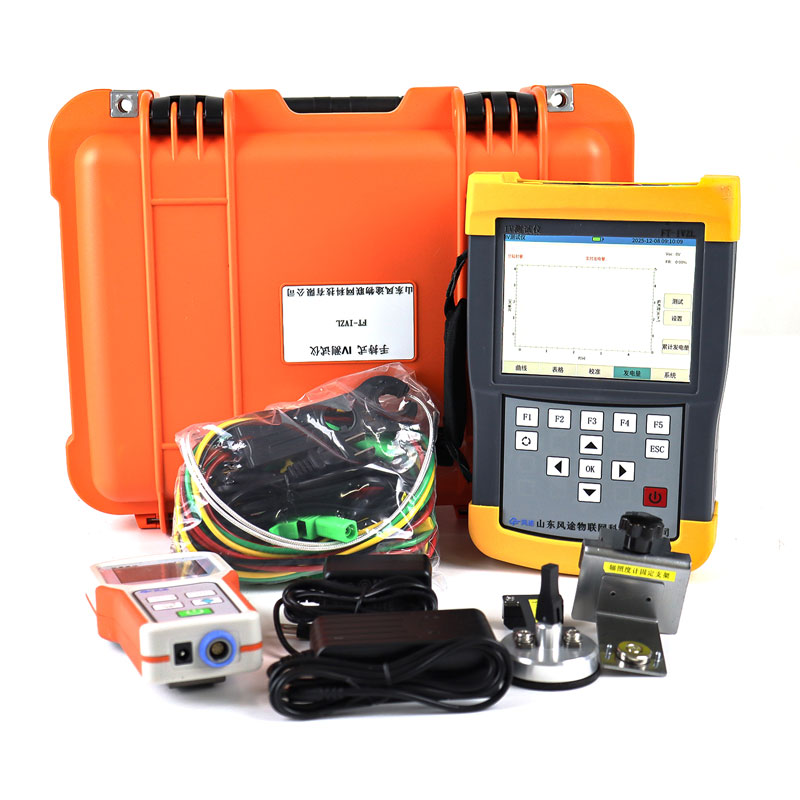
PV Module IV Curve Tester Measures 400V Module Open-Circuit Voltage and Short-Circuit Current
Article source:Weather station time:2026-04-24 09:31:12 viewed:257times
The PV Module IV Curve Tester features a voltage range of 400V and a current range of 20A, enabling it to test modules up to 1000W. It measures key parameters such as open-circuit voltage, short-circuit current, and maximum power. During field operations, a single measurement takes only 1–2 seconds, allowing users to quickly verify the performance of PV systems.
The PV Module IV Curve Tester is a specialized device designed for the on-site testing of the current-voltage (IV) characteristics of PV modules or systems. For high-voltage PV system diagnostics, the device offers a voltage testing capability of 400V and a current testing capability of 20A, thereby meeting the comprehensive parameter measurement requirements for PV modules rated up to 1000W. Core parameters obtainable from the tester include open-circuit voltage, short-circuit current, maximum power, and fill factor; these parameters serve as the basis for evaluating a PV module's power generation performance and conversion efficiency.
In terms of testing principles, the IV curve tester utilizes a built-in electronic load module to simulate the full spectrum of load variations—ranging from a short circuit to an open circuit. Under stable irradiance conditions, it measures the current value corresponding to each voltage point, thereby plotting a complete IV characteristic curve. The device's operational workflow is straightforward: after powering on, the unit performs a 10–15 second self-diagnostic check; the positive and negative terminals of the module are then connected to the tester's input ports; finally, the user configures the module parameters via the touchscreen interface and initiates the measurement. The measurement process takes approximately 1–2 seconds, after which the IV curve and all associated parameters are displayed. The actual measured IV curve data is typically corrected for temperature and irradiance variations, converting the results to corresponding values under Standard Test Conditions (STC) to facilitate comparison with the module's factory-specified nominal values.
The application scope of this device spans the entire lifecycle of a PV power plant. During the manufacturing quality control phase, the IV tester is employed to perform electrical performance testing and grading of modules prior to shipment, thereby ensuring product quality consistency. During the power plant commissioning and acceptance phase, testing personnel utilize the device to re-verify the IV curves of newly installed PV arrays, confirming that any power losses incurred during transportation and installation remain within permissible limits. During routine operations and maintenance, O&M teams regularly conduct re-measurements of the I-V curves for PV strings. By comparing these results against the power plant's initial baseline data, they can accurately assess the extent of module performance degradation and rapidly identify various types of faults—such as underperforming modules, shading effects, hot spots, and bypass diode failures. Furthermore, some devices are equipped with high-precision irradiance and temperature sensors capable of simultaneously recording on-site environmental conditions, thereby enhancing the comparability and traceability of the measurement data.
Regarding compliance with international and national standards, IEC 60891:2021 specifies the procedures for correcting the temperature and irradiance characteristics of I-V measurements for PV devices; my country has adopted this standard identically as a national standard. Consequently, high-quality I-V curve testers must not only possess accurate measurement capabilities but also be able to effectively translate on-site field data into parameters normalized to Standard Test Conditions (STC). This enables consistent comparisons of test results obtained at different times and under varying environmental conditions, ensuring that the measurement data truly serves the purpose of assessing the long-term power generation quality of PV systems.
This paper addresses:https://fengtuweather.com/industry/929.html
Related products
Related article
-
Odor gas detector Real-time Monitoring of Odor Concentration (OU) and Concentration of Multiple Odor Gases
2025-12-18 -
Price Variations in Six-Element Weather Stations: Driven by Sensor Principles and Configuration Requirements
2026-05-09 -
Odor Monitoring Equipment Covers Nine Odor Pollutant Indicators
2026-05-11 -
Road Weather Station monitors weather changes to support smart transportation
2025-11-18 -
FT-CZ5S Vehicle-Mount Weather Station: Ideal for Off-Road Vehicles with All-Weather Monitoring Capabilities
2025-05-22 -
Vehicle-Mount Weather Station: Mobile Meteorological Monitoring for Vehicle Environmental Testing
2025-07-14 -
Ultrasonic Snow Depth Detectors: Enabling Accurate, 24/7 Snow Depth Monitoring for Meteorological and Traffic Sectors
2025-08-29 -
Series power supply for Photovoltaic Power Plant Module Defect Detection
2025-12-16